

Today's Teacher Is a Catalyst
Servant Leader. Orchestrator. Guide. There clearly is no shortage of models for teaching. While these frameworks are useful, we don’t believe they capture the essence of what it takes to ignite a student’s quest for growth in our digital, disruptive age. From our vantage point, the primary aim and role for today’s teacher is to be a catalyst — propelling kids to discover their unique passions and talents; and ultimately translate these into meaningful life pursuits (be they careers or other future aspirations).
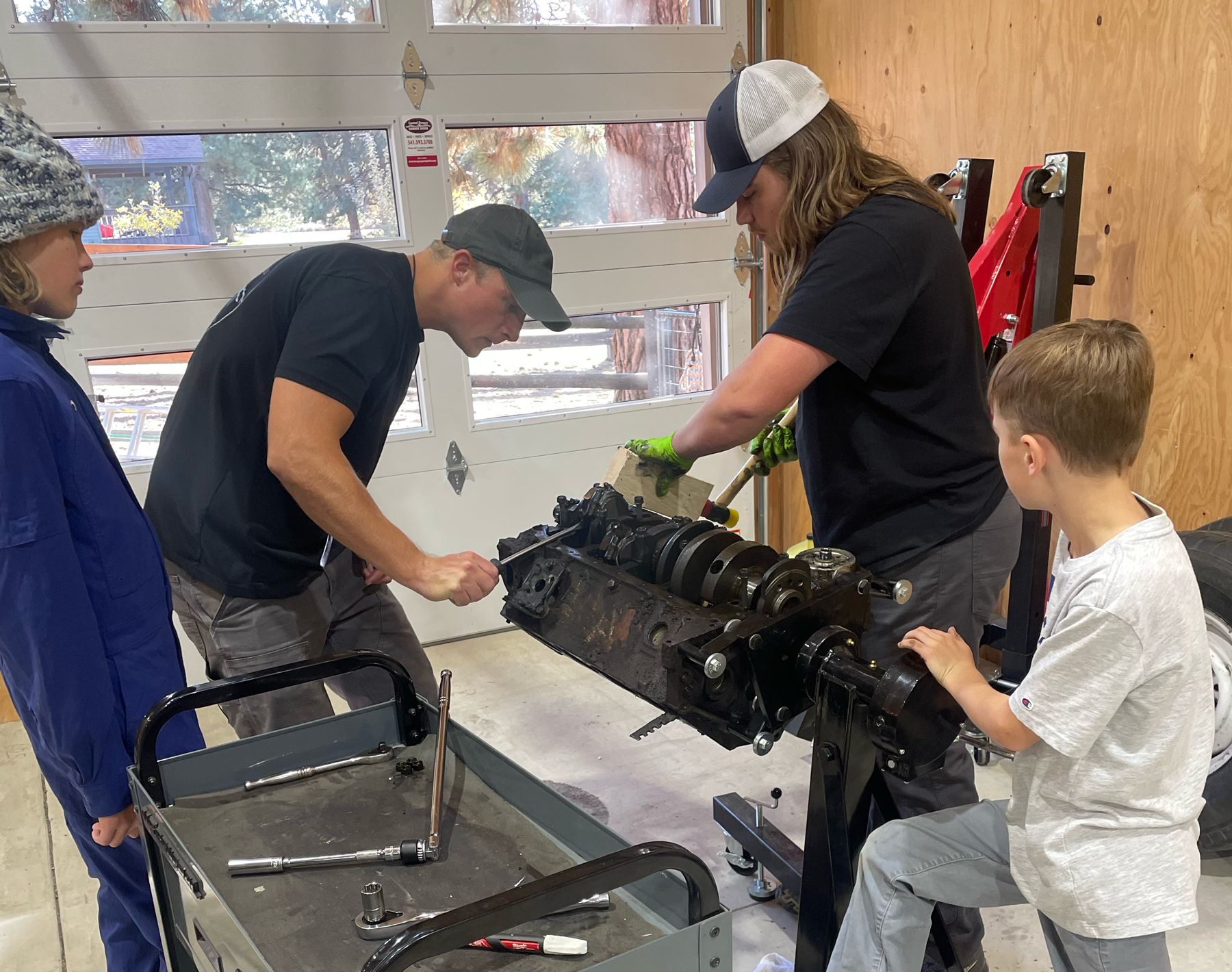
Forge Academy Instructor Sean Dronia works alongside students who are rebuilding a classmate’s 1969 Chevy C10 pickup truck.
There are three key dimensions to being a catalytic educator:
1. Create an environment that is loving, trusting and inspiring.
This is ground zero for unlocking the fullness of a child’s humanity. While love and trust are the price of admission, inspiration is the secret sauce that sparks curiosity and exploration. Not only will kids feel safe to be themselves; furthermore, they will have an impetus to wonder and wander — essential energy for tapping into one’s potential.
2. Design curricula that is innovative and integrative.
It’s astounding that in the year 2026 most schools are still taking a subject-based approach to education. Such a siloed approach — which harkens back to the Industrial Age assembly line — may be more efficient; however, it lacks the connective tissue that the next generation of jobs will demand. Creating learning experiences that ask students to synthesize an array of topics, themes and ideas is more interesting and challenging, not to mention representative of the “connect-the-dots” nature of tomorrow.
3. Unlock the potential of a student.
Nothing is more vexing or important than this final dimension. Teachers, the world over, have been schooled on grading — assessing a student’s performance against a standard benchmark — not on identifying what makes a kid truly unique. Yet in an increasingly complex age — where economies, industries and societies are transformed overnight — yesterday’s rubrics cease to be useful. What matters infinitely more is an individual’s capacity to step fully into their capabilities; in the process identifying their unique genius and how they want to be a leader in the world.

Instructors Ben Haskell and Paul Ruiz lead Forge Academy Students on a hiking expedition at Misery Ridge.
Over the last decade, billions of dollars have poured into EdTech investments. While there has been incremental progress on the margins (Foreign Language apps, Zoom-based virtual learning, et al), it’s past time for the old education paradigm to topple.
With monumental advances in neuroscience, AI, digitization (to name a few), we are poised to finally design and deliver individualized, personalized solutions that accelerate a student’s growth — not for achieving test results; but, rather, for realizing one’s full potential.
This quantum leap, in human capital, certainly hinges upon theory and technology. But, ultimately, it will be catalytic teaching that carries the day.
GEOFF HELT
Co-founder of Forge Academy
